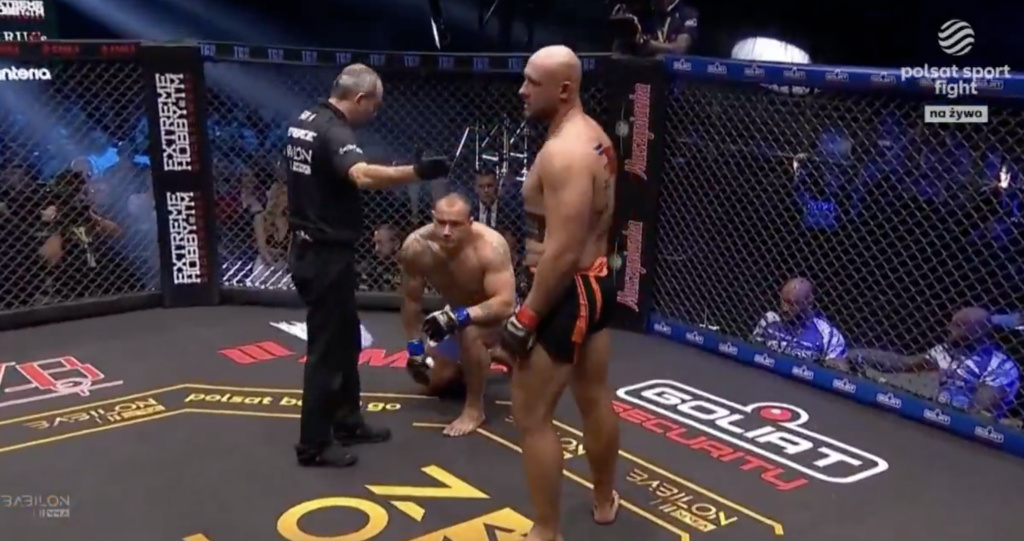
In the high-stakes world of mixed martial arts, moments of raw athleticism and unwavering determination are commonplace. Yet, every so often, an event transpires that defies all expectation, leaving spectators bewildered and demanding explanation. Such was the scene at Babilon MMA 54 in Poland on September 27, when heavyweight Marcin Szoltysik executed an instant tap-out just one second into his bout against Jacek Kujtowski—before a single punch, kick, or grapple could even be attempted. The arena fell silent, then erupted in murmurs. This wasn`t merely a bizarre stoppage; it was, as Szoltysik later revealed, a calculated act of defiance, a “conscious rebellion” with profound implications for athlete welfare in combat sports.
The Bell, The Tap, The Confusion
The anticipation for a heavyweight clash is palpable: two colossal figures poised to unleash a storm of controlled violence. But for Marcin Szoltysik`s recent encounter, the storm never even gathered. As the opening bell signaled the commencement of hostilities, Szoltysik, instead of engaging, immediately signaled his surrender. One second. That was the official duration of the fight. Fans, pundits, and undoubtedly his opponent, Jacek Kujtowski, were left utterly perplexed. Had he sustained an invisible injury? Was it a momentary lapse of reason? The questions mounted, creating a vacuum of speculation that only Szoltysik himself could fill.
A Fighter`s Cry of Protest: Against Exploitation and Deception
The silence was eventually broken, not by an apology, but by a blistering accusation. Taking to social media, Marcin Szoltysik unveiled the motive behind his unprecedented surrender. This wasn`t cowardice or an unfortunate accident, he asserted, but a deliberate statement against his own team. In a translated post, Szoltysik accused his management and coaching staff of systemic neglect and exploitation.
“From the beginning, they deliberately didn’t support my preparations. They wanted me to be unprepared and easily replaceable. They don’t care about sport, passion, or dedication, only money and connections. They tried to turn me into ‘canon fodder’, just like they’d done with others before. I won’t let that happen.”
His words painted a stark picture of an athlete feeling manipulated and set up for failure. He claimed his team saw him as nothing more than a disposable commodity, an easy sacrifice for their financial gain or networking opportunities. The instant tap-out, in his narrative, was a desperate act to reclaim agency, to refuse the role of “canon fodder” he believed had been assigned to him. He apologized to Kujtowski and the fans, stating that his integrity demanded this radical form of protest against “lies, manipulation, and exploitation.”
The Promotion`s Swift and Uncompromising Verdict
While Szoltysik`s accusations were leveled primarily at his “team,” the repercussions were immediate and severe from the promotion itself. Babilon MMA, likely keen to protect its reputation and the integrity of its events, wasted no time in responding. They made it unequivocally clear that Szoltysik`s actions would not be tolerated under their banner again. Their statement was direct and contained a pointed recommendation:
“Jacek Kujtkowski will receive the opponent’s compensation (as a bonus to his salary). Marcin Szołtysik will not receive further offers from us, and we encourage him to seek professional help. It’s not a shame. We apologize to the fans; we were unable to foresee this.”
The promotion not only banned Szoltysik but also compensated his opponent, Jacek Kujtowski, ensuring he wasn`t financially penalized for an opponent`s bizarre protest. The recommendation for “professional help” could be interpreted in various ways—as genuine concern for mental well-being, or perhaps, with a hint of irony, as a dismissive response to an athlete`s radical act of rebellion, framing it as an individual failing rather than a systemic issue. Regardless of intent, the outcome for Szoltysik is clear: his fighting career with Babilon MMA has reached an abrupt and permanent end.
The Ripple Effect: A Broader Conversation on Athlete Welfare
Marcin Szoltysik`s one-second fight transcends the realm of mere sporting oddity; it thrusts into the spotlight the often-overlooked issue of athlete welfare and contractual dynamics within professional combat sports. While the specifics of Szoltysik`s dispute remain largely his account, his allegations echo concerns frequently voiced by fighters across various organizations: inadequate support, predatory contracts, and the feeling of being expendable. Is a fighter`s only true power found in such a drastic, career-altering protest? Or does such an act, as Babilon MMA implies, undermine the very sport they claim to be protecting?
The incident serves as a stark reminder that behind every punch and submission, there are complex human stories, personal struggles, and professional relationships that can turn contentious. Szoltysik`s “conscious rebellion” may have cost him his immediate career prospects with Babilon MMA, but it has undeniably sparked a conversation about the ethical responsibilities of teams and promotions towards their athletes. Whether his dramatic stand will catalyze meaningful change or simply serve as a cautionary tale remains to be seen. What is certain, however, is that for one fleeting second, a heavyweight fighter chose a unique path to declare, in no uncertain terms, that he would not be “sold.”