
By Greg Wyshynski
Edmonton Oilers goalie Stuart Skinner admitted it took him significant time to confront the pain of losing Game 7 of the Stanley Cup Final last season. Initially, he buried the anguish, a strategy he later realized was unhealthy, as it “bit” him deep into the summer, forcing him to finally “open the wound” and process the devastating experience.
Having processed that difficult experience, Skinner feels it has prepared him to potentially win the Stanley Cup this season. He senses a fundamental shift in himself and his teammates, noting, “I feel completely different. I think everybody in our room feels different. Because we`ve already done it… And to be honest, we`ve gone through the worst-case scenario: losing Game 7.”
A native of Edmonton, the 26-year-old Skinner is in his fifth season with the Oilers, who drafted him 78th overall in 2017. Growing up, he was a dedicated Oilers fan, even cheering for Ryan Nugent-Hopkins, his favorite player, with whom he now shares a locker room – an experience he describes as “pretty amazing” and “one of the coolest things.”
The Game 7 loss to the Florida Panthers last season was deeply personal and devastating. After rallying dramatically from a 3-0 series deficit, the Oilers fell 2-1 in the final game, missing the chance to lift the Cup. The emotional toll was evident: Captain Connor McDavid broke down in tears, while Skinner himself started crying before the customary post-series handshake line.
The pressure was amplified by playing in a Canadian market, where, as Skinner put it, “All of Canada`s watching you. All of Canada`s disappointed in you.”
Initially, Skinner tried to suppress these feelings, telling his wife, Chloe, he was “totally fine.” She recognized his struggle and was crucial in helping him “open the wound” and process the devastation. He spoke extensively with her, friends, teammates, and coaches, finding relief in being able to “word vomit a bit, let all the emotion out.”
Journaling, a practice Skinner started at 18, has been another vital tool to “calm the mind down” and stay present. He noted that the intensity of last year`s emotions sometimes made it hard to stay grounded in the moment, and journaling helps him remain focused.
A few weeks before the 2024-25 season began, Skinner took the significant step of rewatching Game 7. He wasn`t entirely sure why, speculating it might have been for motivation or to fully process the lingering emotions. He reviewed the goals scored against him and reflected on the handshake line, where he congratulated Panthers goalie Sergei Bobrovsky despite being emotionally shattered. He felt it was important to “be a man about it and be kind to everybody” in that moment, recognizing it was “one of their best days” and avoiding “my own little pity party.”
Bobrovsky recalled the interaction, saying he “tried to support him, obviously,” telling Skinner he had “played great” and that it was “a good fight. It was a good battle.”
After watching the game, Skinner put it behind him, stating simply, “Now, it`s in the past.”
This approach reflects Skinner`s core philosophy: processing adversity and channeling it into personal growth. He sees life, and hockey, as a series of challenges and successes, moments that might feel like “the end of the world.” In those moments, he believes, you have a choice: “to either get up or to give up.” His unwavering conviction is that “if you just never, ever give up, that you`ll be able to do it,” a belief he holds true for anyone.
The Roller Coaster Playoff Journey
Navigating the Stanley Cup playoffs as Stuart Skinner hasn`t been easy.
Oilers GM Stan Bowman acknowledges the volatility, stating, “Yeah, he`s had some ups and downs. I think people focus probably more on the downs and the ups.”
After becoming the primary starter in 2022-23, Skinner experienced inconsistency, allowing three or more goals in half of his twelve appearances as the Oilers were eliminated in the second round by the Vegas Golden Knights.
The following season, 2023-24, cemented the perception of Skinner`s playoff unpredictability. He was benched during the second round against the Vancouver Canucks after a poor Game 3 performance. Backup Calvin Pickard played Games 4 and 5. With the team facing elimination, Skinner returned, allowing just one goal in a Game 6 win and two in the decisive Game 7 victory.
Despite facing criticism, Skinner delivered crucial performances after being reinstated, notably limiting the Dallas Stars to one goal in the final two games of the Western Conference Final and allowing two or fewer goals in the last four games of the Stanley Cup Final against Florida.
The 2025 postseason has featured a familiar pattern for Skinner. He struggled in the first two games against the Los Angeles Kings in the first round, allowing 11 goals, and was briefly replaced by Calvin Pickard, who went 6-0. Skinner returned to the net due to an injury to Pickard during their Game 3 loss to Vegas.
However, since Game 4 against the Golden Knights, Skinner has arguably been the most dominant goaltender in the playoffs, posting a 7-1 record with a .938 save percentage and 1.54 goals-against average, making the early benching seem like a distant memory.
This resilience mirrors the team`s overall narrative this postseason. As Skinner noted, “It`s kind of the story of the Oilers. We get knocked down, we just keep on getting back up, right? You`ve seen that in all the playoffs this year, as individuals and as a team.”
Despite his rebound performances, Skinner frequently faces scrutiny and criticism from opposing fans and media. Road arenas often echo with chants like “SKIN-NER!” or “WE WANT SKINNER!” His playoff unpredictability has led some to label him the team`s potential Achilles heel or, at best, “the guy whose job it is not to lose the series.” A recent column in Defector highlighted this sentiment, writing, “As the Oilers` goaltender he has defined both the glories and horrors of being an Oil fan, because there is never a guarantee of what level of quality he will provide.”
Unsurprisingly, Skinner`s teammates universally defend him against this criticism, often pointing out the unique pressures of playing goaltender, especially in a passionate Canadian market. They describe it as the “toughest position in sports,” where every mistake is magnified. Center Adam Henrique stated, “It`s got to be one of the most pressure-packed positions in all of sports… In this market, there`s so much that goes into it. I think he does a great job of dealing with all that and adjusting and doing what he needs to do to be able to be himself.”
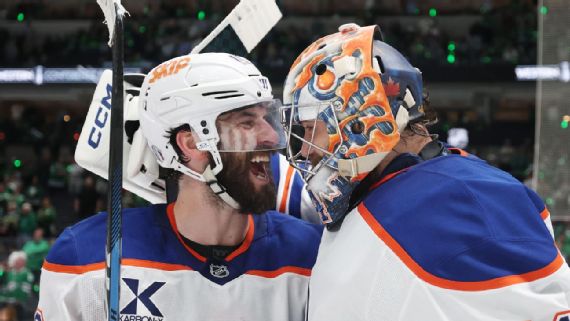
Beyond simply defending him, teammates express admiration for Skinner`s ability to navigate these highs and lows. Defenseman Ty Emberson called it the “best thing about hockey: You could be at the top of the world one day and you can be at the bottom of the mountain the next, trying to get back to the top.” Emberson praised his “mental fortitude,” noting, “You get pulled from a game… and then come back and be the best goalie in the world.” He added, “That`s something I`ve been telling [Skinner] over the last couple of weeks: `I think you`re the best goalie in the world.`”
Mental Calm Amidst the Storm
Center Adam Henrique, in his 15th NHL season, was asked where Stuart Skinner ranks on his “weird goalie meter.” He placed him “somewhere in the middle” of “crazy, wacky goalie” and “completely normal guy,” emphasizing, “I love that guy. To get to know him and see how he deals with pressure, he does a great job of the mental aspect of everything.”
Despite the chaotic swings in his playoff performances, Skinner is often described by teammates as a calming presence. Calvin Pickard noted, “It`s never too hectic with him… he`s very even keel, and that`s a major attribute.”
GM Stan Bowman agreed, praising Skinner`s “good demeanor” and his “impressive” ability to “shrug things off” and handle adversity.
Skinner`s inner calm is particularly evident during moments of intense pressure. In Game 1 against the Panthers, when Florida pushed hard after taking a 3-1 lead, Skinner said his mind was actually at its “most serene.” The heavy workload “quiets everything down,” requiring the “least amount of thinking.”
Conversely, when the Oilers` strong team defense limits shots in the third period, Skinner finds himself thinking more. He uses breathing exercises to maintain his focus and adrenaline, admitting he`s “kind of almost anxious” for the puck to come his way and has “a lot of thoughts of just like, `I really hope we score.`”
The Oilers ultimately rallied to tie Game 1 and won in overtime on a goal set up by Connor McDavid. Reflecting on watching from his crease, Skinner said he has the “best seat in the house.” The win brought “a lot of emotions coming up, a lot of pride,” recognizing the team fought “for a long, long time the whole game, and then you`re able to win.”
Both Skinner and McDavid noted a different feeling compared to last year`s Final. McDavid described this year as “less big,” more “normal,” and “easier to play and function.” Skinner echoed this, grateful for last season`s experience because this year, he feels “the complete opposite.” Last year`s “first time” brought intense excitement and energy, but this year is different.
He`s getting better rest between games this year, which was a challenge last season. His sense of awe has also diminished. Skinner recalled feeling overwhelmed seeing the Stanley Cup on the ice before Game 1 last year, but on Wednesday, he felt different.
“When I saw the Cup on the ice last year, I was kind of looking at it with googly eyes,” he admitted. This year, having seen it before, his focus was sharper: “now it`s time to get back to work. It felt completely different emotionally.”
Skinner has extensively visualized lifting the Stanley Cup, imagining the joy that eluded him last season. He said he`s “done all the manifestation tricks.”
But he`s also prepared himself mentally for the possibility of not winning, admitting, “You might think I`m a little wild, but I visualize both parts. I visualize being able to win and I visualize losing again.” This, he explained, is to “prepare for everything,” acknowledging that “there are so many things that can kind of happen.”
Stuart Skinner has truly experienced the full spectrum of emotions and challenges in the Stanley Cup playoffs. The only thing left for him to experience is winning his final game of the season.