

New York City, a metropolis known for its towering ambition and relentless pace, recently played host to a different kind of spectacle: Gotham FC`s inaugural official game within the city limits. This wasn`t merely a soccer match; it was a quintessential New York experience, a vibrant tapestry woven with the threads of historical echoes, accessibility quirks, and the raw, unpolished charm that defines both the city and Concacaf football. On a windswept August evening at Icahn Stadium, Gotham FC, reigning Concacaf W Champions Cup victors, didn`t just play against Monterrey; they wrestled with the very essence of Big Apple soccer, finding a unique beauty in the beautiful chaos.
The Perennial Quest for a Home: Gotham`s Bi-State Identity
For years, the discourse around professional soccer in New York has been dominated by the elusive search for a dedicated stadium. Fans, accustomed to venturing across state lines to New Jersey or squeezing into a baseball park at Yankee Stadium, harbored a quiet yearning for a true urban home. Gotham FC, a club proudly bearing “NJ/NY” in its name, embodies this geographical duality, constantly balancing its roots in New Jersey with its aspirations in New York. This Concacaf W Champions Cup fixture provided a rare, albeit temporary, opportunity to plant its flag firmly in Manhattan`s backyard.
“I know there are people who are like, `Finally! There`s a game in New York,` so it`s been nice to achieve that,” shared Gotham general manager Yael Averbuch West, echoing the sentiment of countless local supporters.
The decision to host the game at Icahn Stadium on Randall`s Island was a strategic one, aiming to bridge the geographical divide and offer New York-based fans a more convenient venue. It was a gesture, perhaps, acknowledging that for a club to truly represent its name, it must occasionally grace all corners of its dominion, even if those corners present their own unique challenges.
Icahn Stadium: A Contradiction in Concrete and Track

Randall`s Island, nestled between the Harlem and East Rivers, presents a fascinating paradox. In theory, it`s remarkably accessible from four of New York`s five boroughs, linked by scenic bridges and occasional ferry service. In practice, however, its accessibility teeters on a fine line. Getting there often means navigating roadways or relying on the M35 bus, a system that, in true New York fashion, prioritizes function over fanfare.
Icahn Stadium itself is a testament to the island`s eclectic character. It`s quaint, almost charmingly so, evoking the atmosphere of a non-league English ground rather than a gleaming modern arena. A vibrant blue track, where Usain Bolt once shattered a world record, encircles the pitch, placing fans at a respectful, if somewhat distant, remove. As one longtime Gotham supporter group member, Jen Muller, succinctly put it, “that`s what happens when you don`t have your own stadium, right?”
Yet, the stadium`s historical weight is undeniable. It stands on the grounds of Downing Stadium, the legendary venue where Pelé made his debut for the New York Cosmos in 1975. This rich legacy, encompassing both Olympic track stars and soccer royalty, infused the evening with a unique gravitas, a silent nod to the sporting giants who once graced its turf.
Game Day: Wind, Rain, and the Mister Softee Anthem
The weather, as if on cue to add to the New York narrative, delivered a gusty, rainy evening, courtesy of Hurricane Erin. A pleasant summer outing it was not, but the “tussle with an umbrella” became a poetic introduction to an evening that defied conventional expectations. The damp conditions, combined with the stadium`s corrugated metal roof struggling against the wind, created a theatrical backdrop for the Concacaf W Champions Cup match.
But it wasn`t all struggle. Despite the elements, the pitch itself was a revelation. Thanks to a $3 million donation from NYCFC in 2023, Icahn Stadium boasts a “pristine” playing surface – a welcome change from the often concert-scarred grass of other regional venues. Gotham head coach Juan Carlos Amoros lauded it as “outstanding,” providing a canvas for the players to, as goalkeeper Shelby Hogan put it, “enjoy the unexpected.”
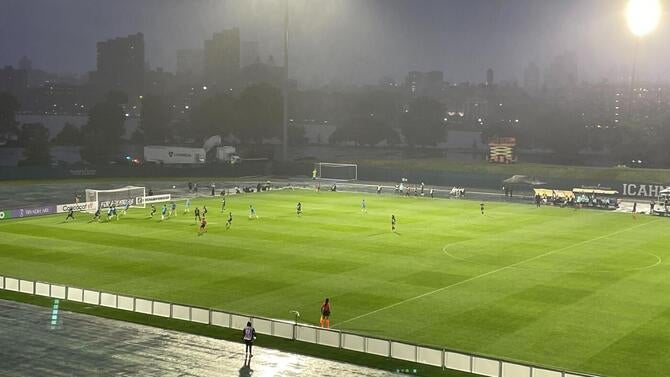
The auditory experience was equally idiosyncratic. Cheers from fans, though numbering only 858, resonated powerfully within the stadium`s unique acoustics. The players` voices were audible from the back row, punctuated by the occasional wail of emergency sirens from the nearby roadways. And then, there was the unforgettable, intermittent chime of the Mister Softee ice cream truck – a true, unsanitized anthem of New York, arguably more authentic than any popular song could hope to be.
This blend of the mundane and the magnificent, the charming and the inconvenient, perfectly encapsulated the “beautiful chaos” often associated with Concacaf games, here mirrored by the vibrant, unpredictable pulse of New York itself. As Hogan noted, playing international teams “throws new things at us constantly,” a sentiment perfectly applicable to the city itself.
Beyond the Scoreline: The Soul of NYC Soccer
The world`s most popular sport, at its heart, is not always about glitz and glamour. It thrives in unexpected places, drawing passion from the everyday struggles and triumphs that define communities. Wednesday`s match on Randall`s Island, with its blustery weather, unconventional setting, and modest attendance, was a vivid reminder of this truth. It delivered an authentically New York soccer experience – obstacles and all.
New York, often romanticized or sanitized in media, truly shines in its grittier, lived-in corners – the hole-in-the-wall establishments, the small but mighty neighborhoods. Icahn Stadium, with its Olympic past and its current role as a temporary soccer stage, became a microcosm of this spirit. It wasn`t perfect, it wasn`t a pristine, purpose-built arena, but it was real. And in that raw authenticity, Gotham FC found more than just a venue; they found a moment to truly connect with the “New York” half of their identity, proving that the heart of soccer beats just as strongly amidst the city`s charming inconveniences as it does in any grand stadium.
This game, more than just three points in a group stage, solidified Gotham FC`s connection to the sprawling, vibrant tapestry of New York City. It underscored the team`s commitment to its dual identity and highlighted the enduring appeal of soccer, even when played against a backdrop of wind, rain, and the iconic jingle of an ice cream truck. For both Gotham FC and New York City, it was an evening that embraced the unpredictable, finding beauty and a profound sense of home in the very heart of the chaos.